The fitness industry sells strength as a look. Bigger arms, a flat stomach, more plates on the bar. Fine if you want that. But that's not why I care about strength.
I care about it because of questions like these:
- Can you stand up from a chair without pushing off your knees?
- Carry the shopping from the car in one go?
- Put a suitcase on a shelf?
- Catch yourself when a step isn't where you thought?
- Get down to the floor and back up again?
Those aren't gym questions. They're life questions. And the answer at 80 depends on what you do now.
Why it's a health issue
In large studies, people with low strength tend to have worse mobility, more trouble with daily tasks and higher health risks. That doesn't mean your grip strength predicts your future. Linked is not the same as caused, and a home test is not a medical exam.
But it does mean strength deserves the same place as walking, sleep and food in any honest plan for getting older well.
I think of it as a reserve: the gap between what daily life asks of you and what you can safely do on a good day. The bigger that gap, the more room you have when life asks for more than usual. Training is about not letting that gap shrink without noticing.
Muscle, strength, power: not the same
- Muscle mass: how much muscle you have.
- Strength: how much force you can produce.
- Power: how fast you can produce it.
- Function: whether all of that actually helps in real tasks.
Someone with normal-looking arms can be very strong for their size. Someone else can lift heavy slowly but not react fast enough to catch a stumble. That's why the mirror is a bad health dashboard. And a bathroom scale that "measures muscle percentage" can't tell you if you can lower yourself into a chair with control.
The five things to train
Forget one heroic lift. Train these five patterns:
1. Get up
Legs, coordination and balance in one. Track it at home with the same chair, shoes and rule for using your hands. What counts is your own trend, not a stranger's number.
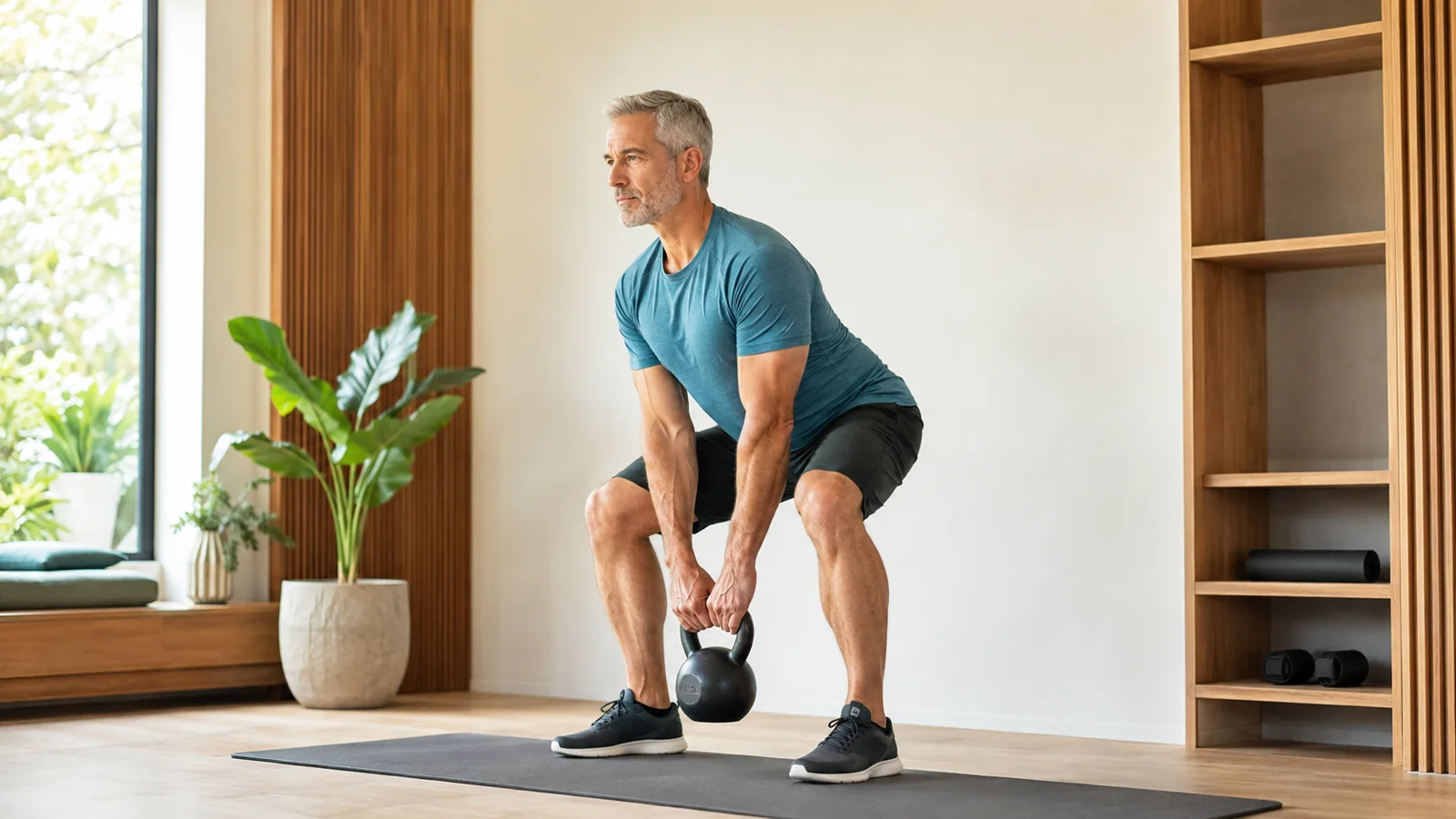
2. Bend and lift
Laundry baskets, garden tools, boxes, grandkids. Lift with your hips and legs, not a rounded back. Start with something light from a raised surface. The load stays close, the feet stay planted, every rep looks the same.
3. Carry
Grip strength is used a lot in research because it's quick to measure and linked to overall strength. But carrying tells you more: grip, core, hips, walking and breathing at the same time. Get better posture or distance first, heavier bags later. Never carry something you couldn't put down calmly.
4. Push and pull
Heavy doors, moving furniture, steadying yourself. Wall or incline push-ups and band rows train this without having to get on the floor. Joints that keep hurting mean change the setup or get it looked at, not "be tough".
5. Balance and step
Strength is only useful if you can use it standing, turning and stepping. That's why the guidelines for older adults combine cardio, strength and balance. A step-up next to a counter shows you weak links a seated machine never will.
My rule: test the task, train the pattern
A test is a snapshot. Max-testing every week mostly measures how much you like testing. Do this instead:
- Pick one everyday task, for example five calm chair stands, or two bags along the hallway.
- Fix the setup: same chair, route, shoes, support, time of day.
- Quality before numbers: pain, balance, breathing and control first.
- Train the pattern for 4–6 weeks. Don't test it hard every session.
- Retest the same way. Look for steadier and easier, not just bigger numbers.
My monthly 10-minute check is exactly this, with a printable worksheet.
The minimum week
Strength work for all major muscle groups at least twice a week. One session can be:
- squat or chair stand,
- hip hinge,
- push (wall, counter or machine),
- pull (band, cable or machine),
- a carry or step-up.
Start with a version where you could do a few more reps than you do. One or two good sets is enough when you're new or coming back. Then change one thing at a time: reps, range, weight, sets or difficulty.
At some point it has to get properly hard, because lifting something that never challenges you gives your body no reason to change. But hard doesn't mean grinding, holding your breath or losing form. The last rep should still look like the first.
And recovery is part of training. You get stronger between sessions, with enough food, protein and sleep. Soreness is not a score.
What progress really looks like
Less dramatic than a transformation photo, and much more important:
- less pulling on your hands to stand up,
- sitting down softly instead of dropping,
- carrying the same bags without leaning,
- lifting from a lower surface safely,
- stairs without hesitating,
- no joint pain the next day,
- confidence coming back after a lazy period.
The same task costing less effort is progress. Exactly what daily life needs.
When to get help instead of training harder
New weakness, repeated falls, losing weight without trying, extreme tiredness, suddenly being unable to do things, ongoing pain, numbness, chest symptoms, or breathlessness way out of proportion: see a doctor.
Recent surgery, heart or lung problems, uncontrolled blood pressure, an acute injury, serious osteoporosis or past fractures, a neurological condition, or a doctor's restriction? Get individual advice before starting.
Bottom line
Train so the floor is still reachable. So a shopping bag is just a bag, not an obstacle. So that when life asks for more than usual, you have something left in the tank.
Sources
- U.S. Department of Health and Human Services: Physical Activity Guidelines for Americans, 2nd edition
- CDC: Physical Activity Guidelines for Older Adults
- PubMed: Handgrip Strength, Function, and Mortality in Older Adults
- PubMed: A 30-Second Chair-Stand Test as a Measure of Lower-Body Strength
- PubMed: Physical Performance Measures as Predictors of Mortality