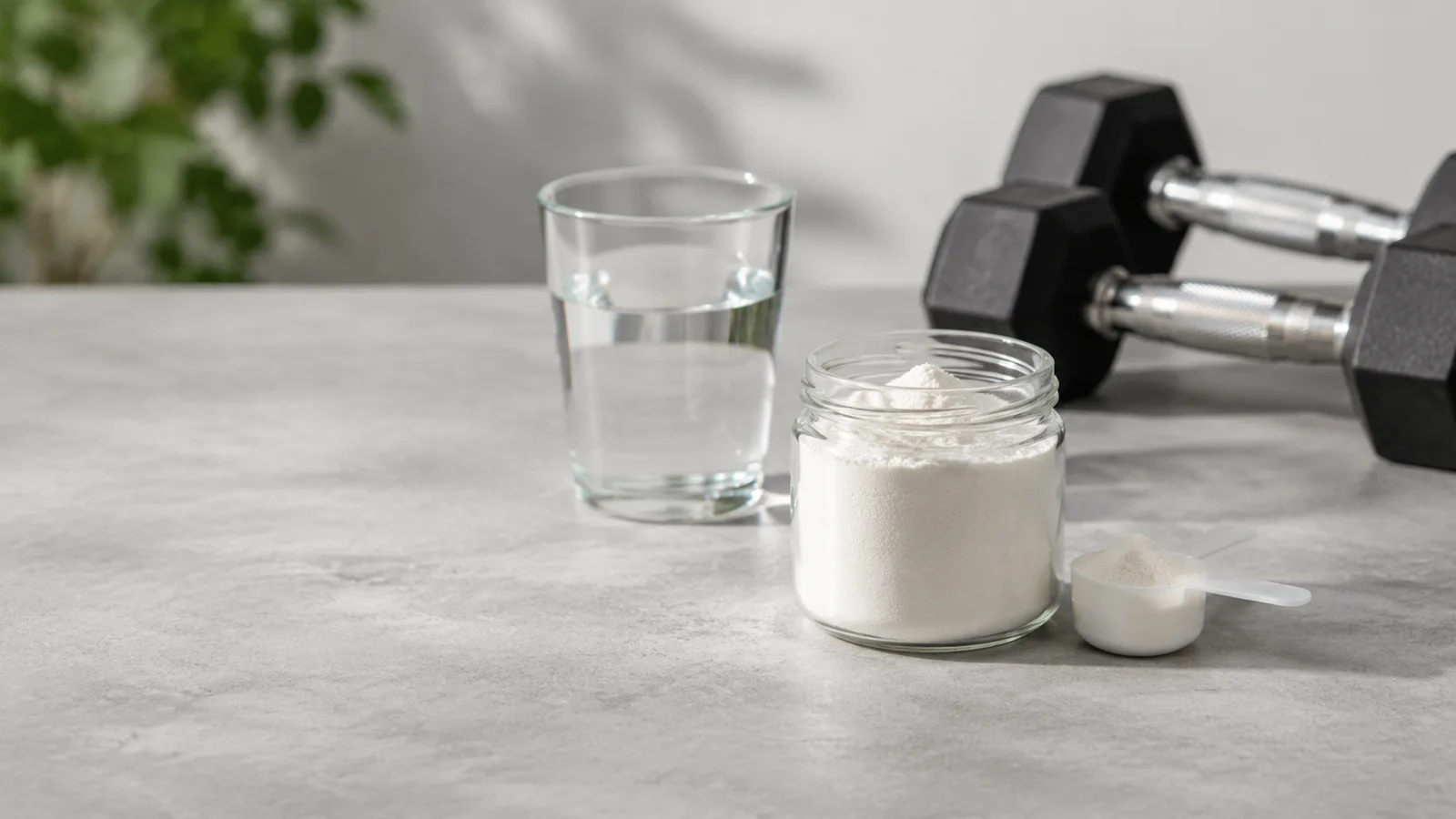
Creatine is a weird case. It's one of the most researched sports supplements there is, and yet it's sold with the same shouty language as a random "fat-burning pump matrix". Once you're over 50 the promises get even bigger: save your muscles, sharpen your brain, stop frailty, reverse ageing.
The truth is more useful and less exciting.
Your body makes creatine itself, and you get some from meat and fish. In your muscles it helps refill a quick energy store you use for short, hard efforts. Taking it as a supplement can increase that store. That part is real. It doesn't mean every promise on the tub is.
Where it actually makes sense
The best case: creatine monohydrate together with regular strength training. Reviews in older adults suggest that combination can improve some measures of strength and lean mass more than training alone. Results vary between studies, doses and programmes.
"Together with training" is the key. Creatine doesn't replace lifting. If you don't train, sleep badly and eat too little, you're asking a powder to fix the wrong problem.
The US NIH says creatine may improve strength, power and work during short maximal efforts, and that people respond differently. It also warns that multi-ingredient sports products are hard to judge, because the combinations and amounts vary.
My four checks before buying
1. What's the job? "Healthy ageing" is too vague. "Support my two strength sessions a week" is a job. If you can only describe the goal with words like detox, anti-ageing or miracle, the marketing is thinking for you.
2. Is the basic stuff done? Do you actually train regularly? Eat enough, with enough protein? Sleep OK? A supplement might give a small extra. A missing training habit is the big thing.
3. Keep the product simple. Almost all research uses plain creatine monohydrate. One ingredient, so you can see the dose, without caffeine, herbs or "pump" stuff you didn't ask for. Independent third-party testing doesn't prove it works, but it lowers the risk that it's contaminated or not what the label says. "Pharmaceutical grade" and "advanced formula" are just words.
4. Check your health first. Don't start on your own with kidney disease, strange kidney test results, pregnancy, lots of medication, a fluid limit, or a medical test coming up. Creatine can raise creatinine in your blood, a marker doctors use to check your kidneys, without that meaning kidney damage. So tell your doctor you take it, otherwise the result can cause confusion.
Dose, without the drama
Some studies use a short "loading phase", others just a small daily amount. Loading fills the stores faster, but it's not needed. A plain daily dose gets there too, just slower, and can be easier on the stomach.
A commonly studied daily amount is around 3–5 grams. That's what research used, not a personal prescription. Your size, diet, health and doctor can change that.
Timing barely matters. No need for a ritual around some "anabolic window". Just take it at the same time every day so you remember.
What to expect
- Your weight may go up a bit, partly because muscles hold more water. That's not fat. But it does make the scale noisier.
- Stomach trouble? Avoid big single doses.
- Some people notice they can do a bit more in training. Others notice nothing.
What not to expect:
- muscles appearing without training,
- treatment for serious muscle loss (sarcopenia) without a proper check,
- a guaranteed sharper brain,
- fewer falls on its own,
- every gram of extra weight being new muscle.
Research on creatine and the brain, mood and diseases is ongoing, but it doesn't justify calling it a brain pill for everyone.
An honest 8-week test
If you've passed the checks:
- one simple single-ingredient product,
- keep your training the same for two weeks before you start,
- pick two things to track, for example chair-rise reps and the weight you use for rows,
- note your weight and stomach, without panicking about daily swings,
- don't start three other supplements at the same time,
- after 8 weeks: is it noticeable, useful and worth the money?
A test without a goal is just a subscription.
Bottom line
Creatine monohydrate is not fake and not magic. If you already train, it may give a small extra. The most important part of the plan is still the workout, not the scoop. Start with the exercise library if you don't have a programme yet.
Sources
- NIH Office of Dietary Supplements: Exercise and Athletic Performance Supplements
- Journal of the International Society of Sports Nutrition: Creatine Supplementation in Older Adults
- PubMed: Creatine Supplementation and Resistance Training in Older Adults
- CDC: Physical Activity Guidelines for Older Adults