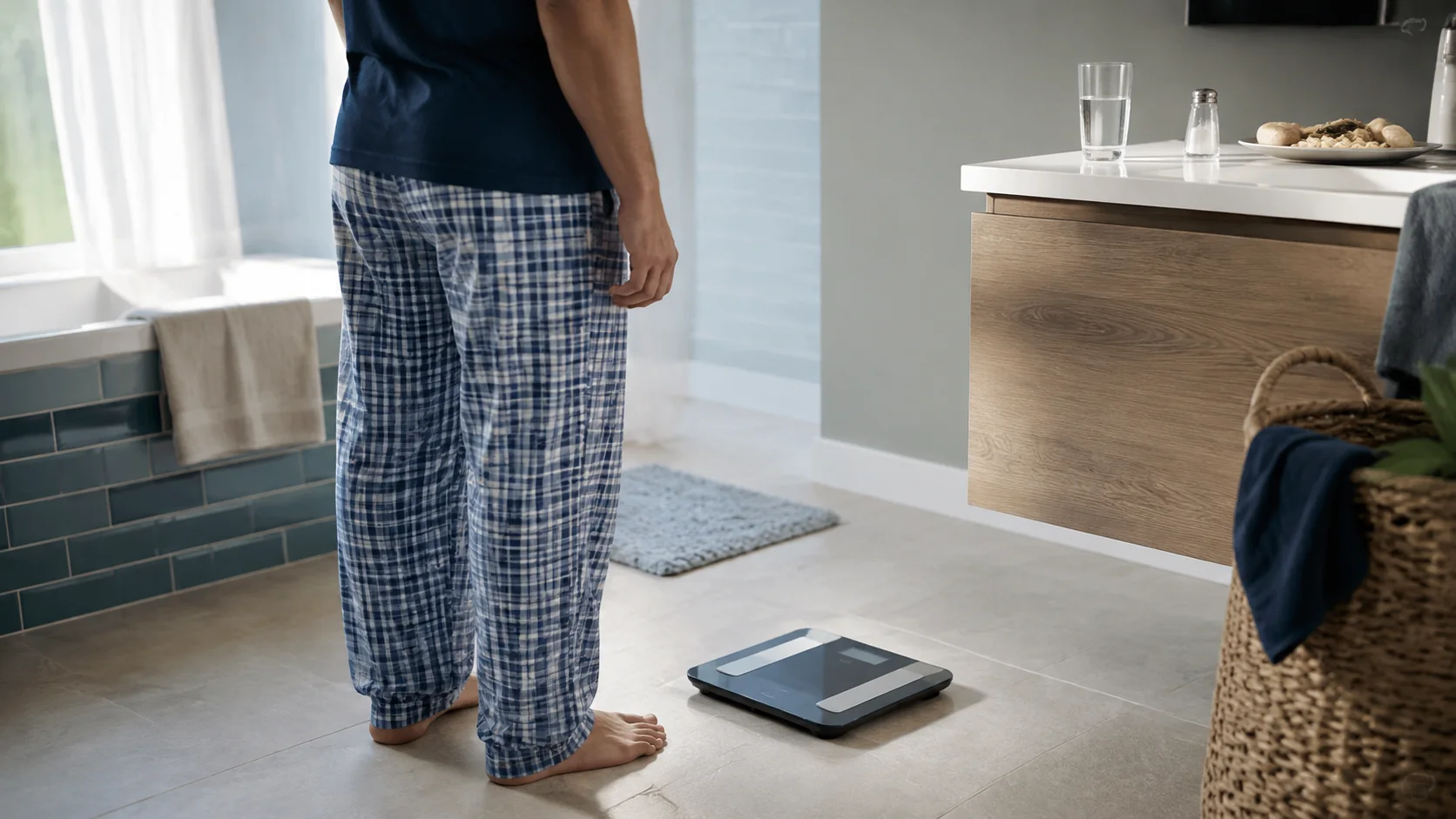
You eat out on Saturday. Sunday morning you step on the scale and it says a kilo more. Panic. The week is ruined, the diet is ruined, might as well eat the rest of the cake.
Stop. Let me spoil the ending right away: you did not gain a kilo of fat overnight. You can't. To store that much fat in one evening you would have to eat thousands of calories on top of what you burn. One restaurant dinner does not do that.
A scale does not measure fat. It measures everything: water, food still in your gut, the carbs stored in your muscles, and yes, fat too. So when it jumps overnight, it is almost always one of these five things.
1. Salt
Restaurant and takeaway food is full of salt. Salt makes your body hold on to water. The American Heart Association lists water retention, bloating and puffiness as effects of too much sodium.
More water in your body = higher number. That's it. It goes back down on its own in a day or two when you eat normally again.
Don't try to "flush it out" by drinking litres of water or skipping meals. Just eat normally.
2. Carbs pull water with them
Your body stores carbs in your muscles and liver as glycogen, and glycogen is stored together with water. Eat a big pasta or pizza dinner and you top up those stores, plus the water that comes with them.
This also explains the famous "I lost 3 kg in the first week of low-carb!" story. Most of that was not fat either. It was glycogen and water leaving. And it comes right back the first time you eat a sandwich.
3. The food is still inside you
Sounds stupid, but people forget it. The dinner you ate at 9 pm has weight. Until it is digested and, well, out, it is on the scale with you. A bigger, later or fibre-heavy meal, constipation, a travel day: all of that changes the number without changing your body.
4. Hormones
If you have a menstrual cycle, your weight can go up and down across the month because of water. Compare the same week of the cycle month to month, not Monday to Tuesday.
What I don't buy is "hormones" as the excuse for everything. If the number keeps going up for weeks, that is not the cycle. That is a trend.
5. You weighed yourself differently
Different time. After breakfast instead of before. Clothes on. Scale on the carpet instead of the bathroom tiles. Weak battery. Every one of these changes the number.
How to weigh yourself so it means something
One number is noise. A trend is information. So:
- Same time, same conditions. Morning, after the toilet, before eating or drinking, no clothes, scale on a hard floor.
- Look at the weekly average, not the single day. Add up the week, divide by seven, compare it to last week.
- Write a short note on weird days: "pizza", "long flight", "hard leg day", "period". Then the weird numbers make sense later.
If the weekly average goes up week after week, that is real and you should do something about it. If one day spikes after a big dinner, do nothing. Eat normally, train normally, and watch the trend.
And honestly: if stepping on the scale every day messes with your head, makes you skip meals or punish yourself with exercise, then stop weighing daily. Once a week is enough. The scale is a tool, not your boss.
When a sudden jump is NOT normal
Sometimes fast weight gain is a warning sign. The NHS and the American Heart Association both mention sudden weight gain together with swelling or breathlessness as possible signs of heart failure.
See a doctor quickly if the weight jump comes with:
- new or worse swelling in your feet, ankles, legs or belly,
- getting out of breath easily, or not being able to breathe lying flat,
- chest pain or feeling faint,
- peeing a lot less than normal.
If you already have a heart, kidney or liver condition, follow the weight and fluid rules your own doctor gave you, not a blog. Including this one.
Bottom line
A kilo overnight is water, salt, carbs and food in your gut. It is not fat. Weigh yourself the same way every time, look at the weekly average, and don't let one number ruin a good week.