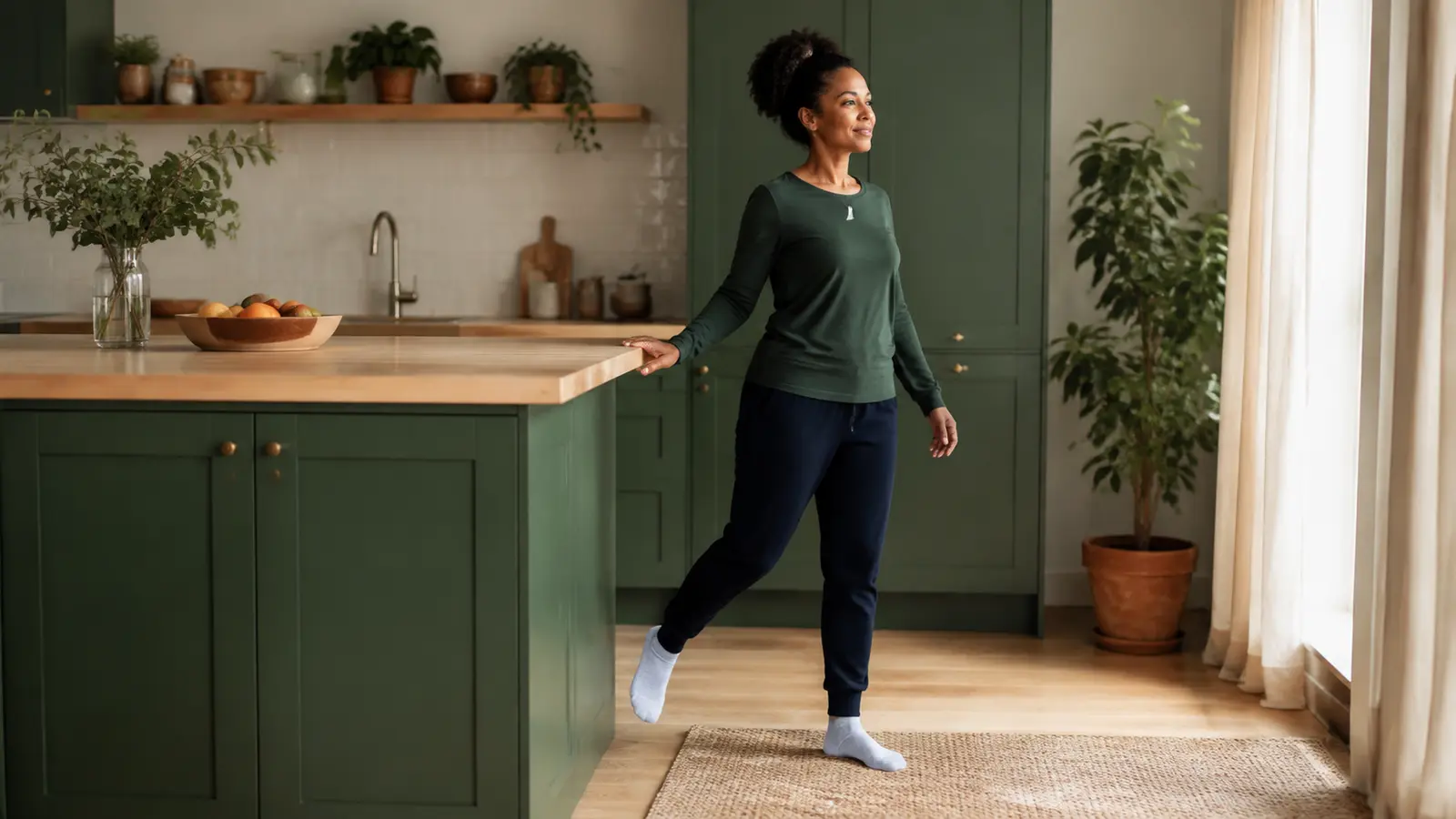
Here is something nobody tells you: balance is not something you either have or don't have. It is a skill. Like riding a bike or typing. You practise it, it gets better. You stop, it fades.
And most adults stopped practising around the age of twelve, when they quit climbing trees and walking on walls. Then at 75 one trip on the rug turns into a broken hip. I'd rather practise now, for five minutes, next to the kitchen counter.
One honest note first: balance also depends on your eyes, your inner ear, the feeling in your feet, your strength and sometimes your medication. A few drills give you practice. They don't tell you why you are unsteady. If you are falling, see someone.
Set up so you can't get hurt
- Stand next to a kitchen counter or something heavy that will not move. A chair on wheels, a light table or a towel rail is not support.
- Wear shoes that grip, or go barefoot on a non-slip floor. Rugs out of the way, pets out of the room.
- If you get dizzy or fall regularly, talk to a doctor or physio first. Don't practise alone if you are not sure you can catch yourself.
Four drills, 30 seconds each
Do each for about 30 seconds, then repeat once if you feel steady. Fingertips on the counter at first.
- Feet together. Stand with your feet close, tall posture, eyes forward.
- Half tandem. One foot partly in front of the other, like you are on a narrow path.
- Weight shifts. Slowly move your weight from one leg to the other and back, without lifting the feet.
- Marching. Lift one knee, then the other, standing tall. Slow and controlled.
The right level is a bit wobbly but under control. If you need to grab the counter or take a step to save yourself, it is too hard. Make it easier.
Make it harder, one thing at a time
Progress like this, and change only one thing per week:
- less hand support: two hands → one hand → one finger → hovering,
- narrower stance: feet together → half tandem → full tandem (heel touching toe),
- longer holds,
- turning your head slowly left and right,
- standing on one leg next to the counter.
Don't close your eyes unless a physio has told you to. Taking away your vision makes balance dramatically harder and that is where people fall.
When standing on one leg gets easy, the single-leg deadlift is the next level. It trains balance and strength at the same time:
When drills are not the answer
Get checked, don't just practise more, if you have:
- new or worsening unsteadiness, dizziness or spinning (vertigo),
- fainting,
- weakness or numbness on one side, or new numbness in the feet,
- a recent knock to the head,
- repeated falls.
Sudden weakness on one side, trouble speaking or a face drooping can be a stroke. That is an emergency. Call your emergency number.
For older adults who are at risk of falling, the CDC's fall-prevention programme looks at the whole picture: strength and balance exercise, a medication review, eyes, feet and the home itself. A drill list is one part of that, not all of it. My home fall-prevention checklist covers the home part.
Myths I don't buy
- "Standing on one leg shows your biological age." One test can't tell you that.
- "Close your eyes, it works better." It works harder, and it's riskier.
- "Bad balance means weak muscles." Sometimes. Often it's the eyes, inner ear, feet or medication too.
- "Five minutes a day prevents falls." It is practice, not a guarantee.
- "The more you wobble, the better." Controlled is better than dramatic.