Google "beginner strength training" and you get two kinds of nonsense. Programmes so complicated you need a spreadsheet and a degree to follow them. Or promises that seven minutes a day will give you a new body.
Neither helps. Here is what does.
Strength training just means making your muscles work against resistance: a machine, a dumbbell, a band or your own body weight. It's not about becoming a bodybuilder. It's about carrying the shopping, getting off the floor, climbing stairs and staying independent for a very long time.
What the guidelines actually ask for
The US Physical Activity Guidelines say: muscle-strengthening activity for all major muscle groups, on two or more days a week. That's it. Not every exercise in existence. Not training until you collapse.
The American College of Sports Medicine updated its resistance-training position in 2026. One of the main messages: lots of different approaches work, and the programme should match your goal. Training for strength is not the same as training for maximum muscle size. As a beginner who wants general strength, you don't need bodybuilder volume, percentage tables or a one-rep-max test.
Five movements, that's your programme
Cover these five patterns and you've trained your whole body:
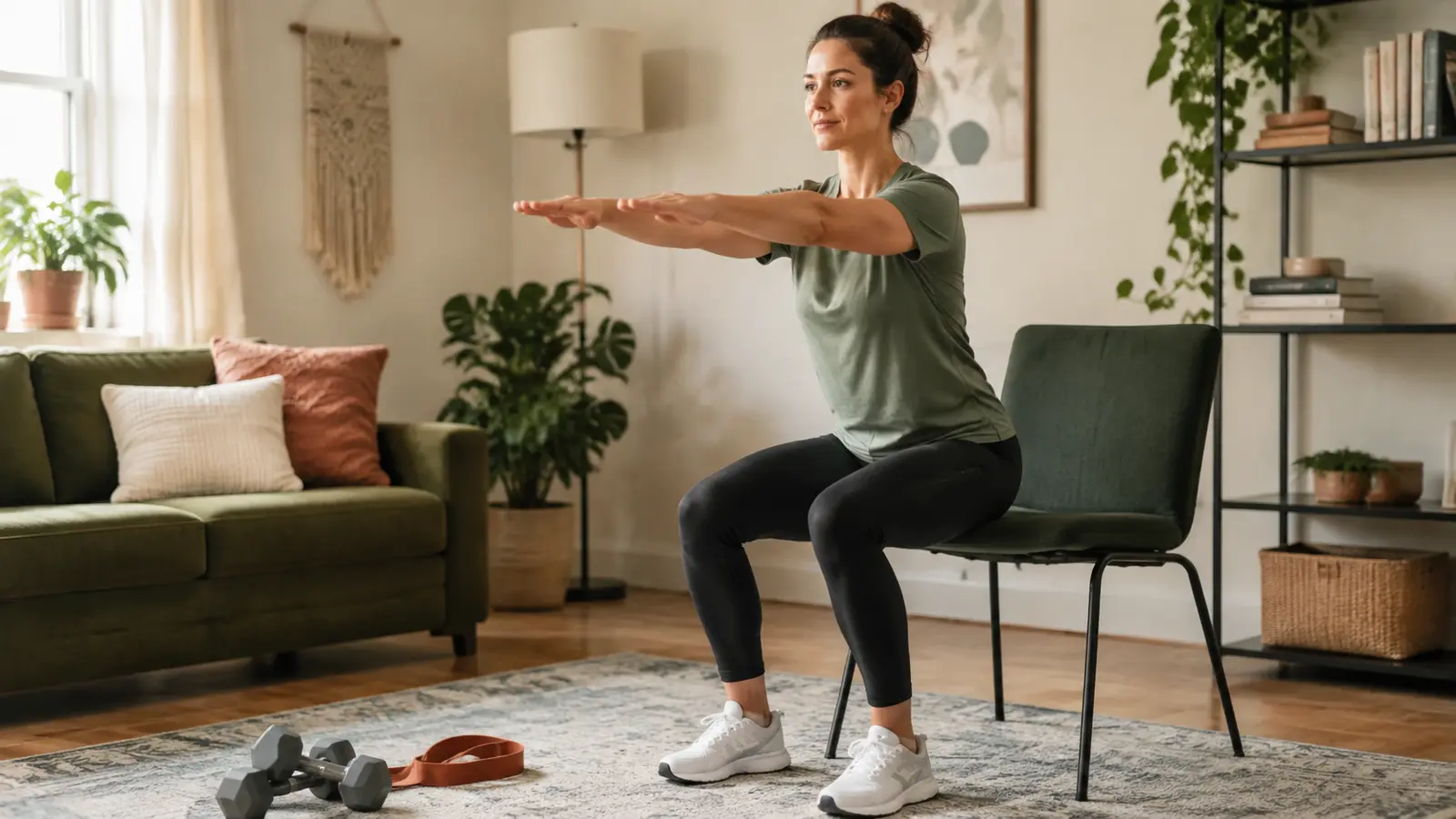
1. Squat (or sit-to-stand from a chair)
2. Push (wall or incline push-up)
3. Pull (band row)
4. Hip hinge (bending from the hips with a flat back)
5. Core / carry
These are examples. If one doesn't suit you (pain, balance, equipment), swap it for another from the exercise library that does the same job.
The plan
| Session | What | Sets | How hard |
|---|---|---|---|
| Day A | the 5 movements | 1 each | stop with a few good reps still in the tank |
| Day B (2–3 days later) | the same, or similar alternatives | 1 each | same |
At least one rest day between sessions. Pick a resistance where your technique stays clean. For many exercises, 6–12 reps is a good range, but don't get religious about the number.
The first two weeks have one job: learn the movements and see how you recover. Not finding out how much you can lift.
Then: one small step at a time
When both sessions feel controlled and you recover fine, change one thing:
- one or two more reps, or
- the smallest possible increase in weight or band, or
- a second set on one or two exercises.
Not all three at once. Write it down: exercise, weight, reps, anything that felt off. A notebook beats muscle soreness as a progress tracker every time.
You don't need to train to total failure as a beginner. Hard, yes. Destroyed, no.
How you know it's working
Not just a bigger number on the dumbbell:
- the same reps feel more controlled,
- you can move through a bigger range without discomfort,
- daily life gets easier: stairs, bags, getting up,
- one more rep with the same good form,
- you recover more predictably.
Before-and-after photos? Lighting, posing and angle. Not a measurement.
Safety that actually matters
- Stable equipment, clear floor.
- Know how a machine works and how to get out of it before you load it.
- Breathe. Don't hold your breath through every rep unless someone qualified taught you why and how.
- Stop for sharp or rising pain, chest pressure, feeling faint, or breathlessness that is way out of proportion.
- Recent surgery, an injury, a chronic condition, pregnancy or bad balance? Get advice from a doctor, physio or qualified trainer first.
Myths, killed
- "Muscle turns into fat when you stop." Two different tissues. Doesn't happen.
- "Women get bulky by accident." No. Marketing myth.
- "If you're not sore, it didn't work." Soreness is not the goal.
- "Everyone has to lift heavy." Heavy is personal, and depends on your goal and experience.
- "One perfect exercise does everything." It doesn't exist.
- "Strength training replaces cardio." You need both.
Before your first session, know:
- your 4–5 exercises,
- how the equipment works,
- what good technique looks like for you,
- when the set ends,
- which symptoms mean stop,
- when your next rest day is.
A simple plan you actually do beats a perfect plan you quit after a week.